
Leopard or Cheetah? A Traveler's Guide to Telling Them Apart
 |
 |
| Cheetah | Leopard |
Few safari mix-ups happen more often than confusing a leopard for a cheetah. Both are spotted, both are sleek, and both can send a first-time visitor's camera into a frenzy of excitement. But beneath the surface, these two cats live almost entirely different lives from how fast they can run to how they raise their young. Here's the full picture.
Body Build Cheetahs are built like sprinters lean, long-legged, and narrow-waisted, with a small, aerodynamic head, non-retractable claws for grip, and an enlarged heart and lungs to fuel short bursts of extreme effort. Leopards are built like powerlifters stockier, more muscular through the shoulders and chest, with a broad head and powerful jaw suited for wrestling prey twice their own body weight up into trees.
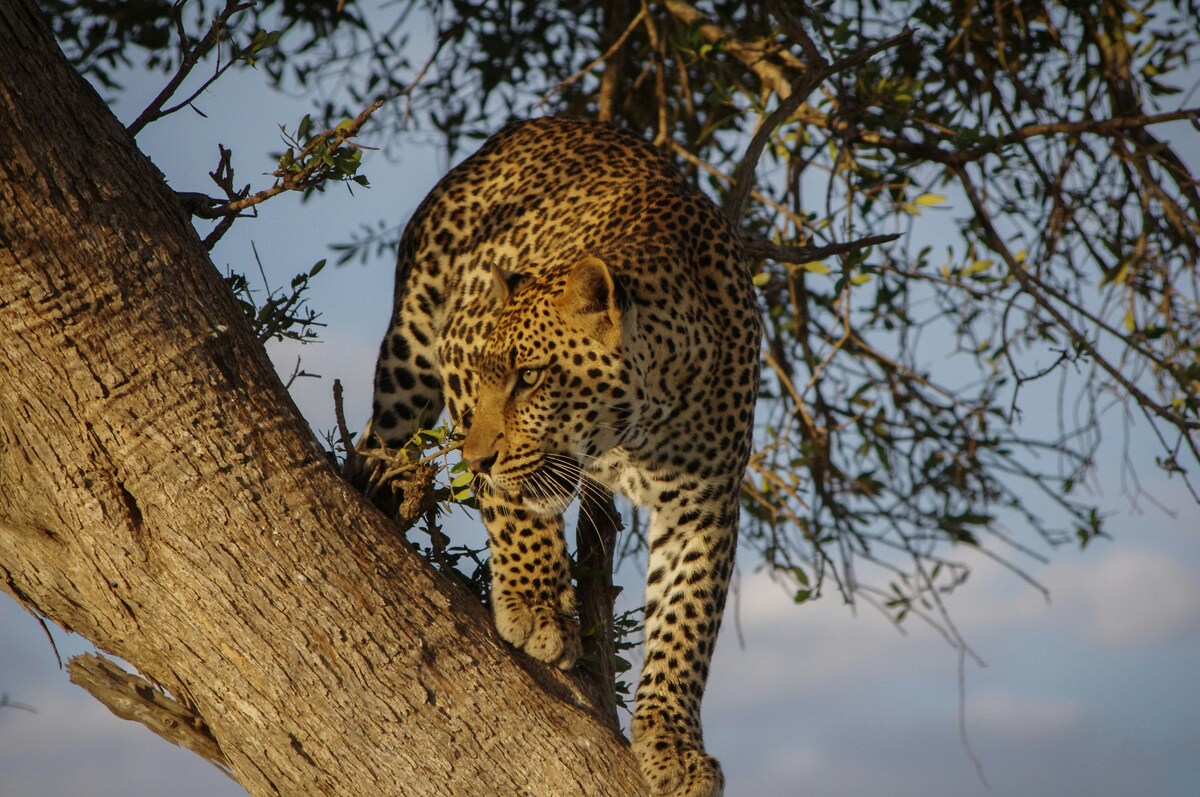
Spot Pattern Leopards have rosettes clusters of small spots arranged in irregular, flower-like rings, often with a darker center. Cheetahs have simple, solid black spots scattered evenly across a tan coat, with no rosette shape at all.
The Tear-Mark Test Cheetahs have a distinctive black "tear line" running from the inner corner of each eye down to the mouth, thought to reduce sun glare while hunting in daylight. Leopards have no such marking.
Speed and the Physics of the Chase This is where the two species diverge most dramatically. The cheetah is the fastest land animal alive, capable of accelerating from 0 to 100 km/h (62 mph) in about three seconds and reaching top speeds near 110–120 km/h in short bursts of 20–30 seconds before overheating forces it to stop. A leopard, by contrast, tops out around 58 km/h and rarely sustains a long chase at all it depends on stealth rather than speed, creeping within a few meters of prey before exploding into a short, decisive pounce.
Hunting Style Cheetahs are daylight hunters, using superb eyesight to spot prey across open grassland, then running it down in a high-speed chase with a success rate of roughly 40–50%. Leopards are largely nocturnal and hunt by ambush, relying on camouflage and patience; they stalk to point-blank range before striking, and once successful, often drag kills far heavier than themselves up into trees to protect the carcass from lions and hyenas.
Social Life and Territory Leopards are strictly solitary outside of mating and cub-rearing, marking and defending territory alone. Cheetahs have a more complex social structure: females are solitary except when raising cubs, but males often form small lifelong coalitions typically brothers from the same litter that hunt and defend territory together.
Reproduction: Gestation and Litter Size
- Leopard: Gestation lasts around 90–105 days. Females typically give birth to 2–3 cubs (occasionally up to 4), hidden in dense cover, caves, or rocky crevices. Cubs stay with their mother for 18–24 months, learning to hunt and climb before becoming fully independent.
- Cheetah: Gestation is shorter, around 90–95 days. Litters are larger, typically 3–5 cubs, sometimes up to 6, reflecting the species' much higher cub mortality as many as 70–90% of cheetah cubs don't survive to adulthood, largely due to predation by lions and hyenas, since cheetah mothers cannot defend them the way a leopard can. Cubs stay with their mother for around 18 months before dispersing.
Habitat Preference Leopards are habitat generalists, thriving in dense forest, mountains, savanna, and even semi-desert, largely because their tree-climbing ability gives them an escape route from larger predators. Cheetahs need open grassland and light woodland to run effectively, which has made them far more vulnerable to habitat loss and is a key reason their populations have declined so steeply.
Quick Rule of Thumb If it's in a tree, it's a leopard. If it's blazing across open plains at extraordinary speed, it's a cheetah. And if you spot a small group of males patrolling together, you're almost certainly watching a cheetah coalition a leopard would never allow the company.